

Top 10 Benefits of Offshore Company Formation in Dubai for International Investors
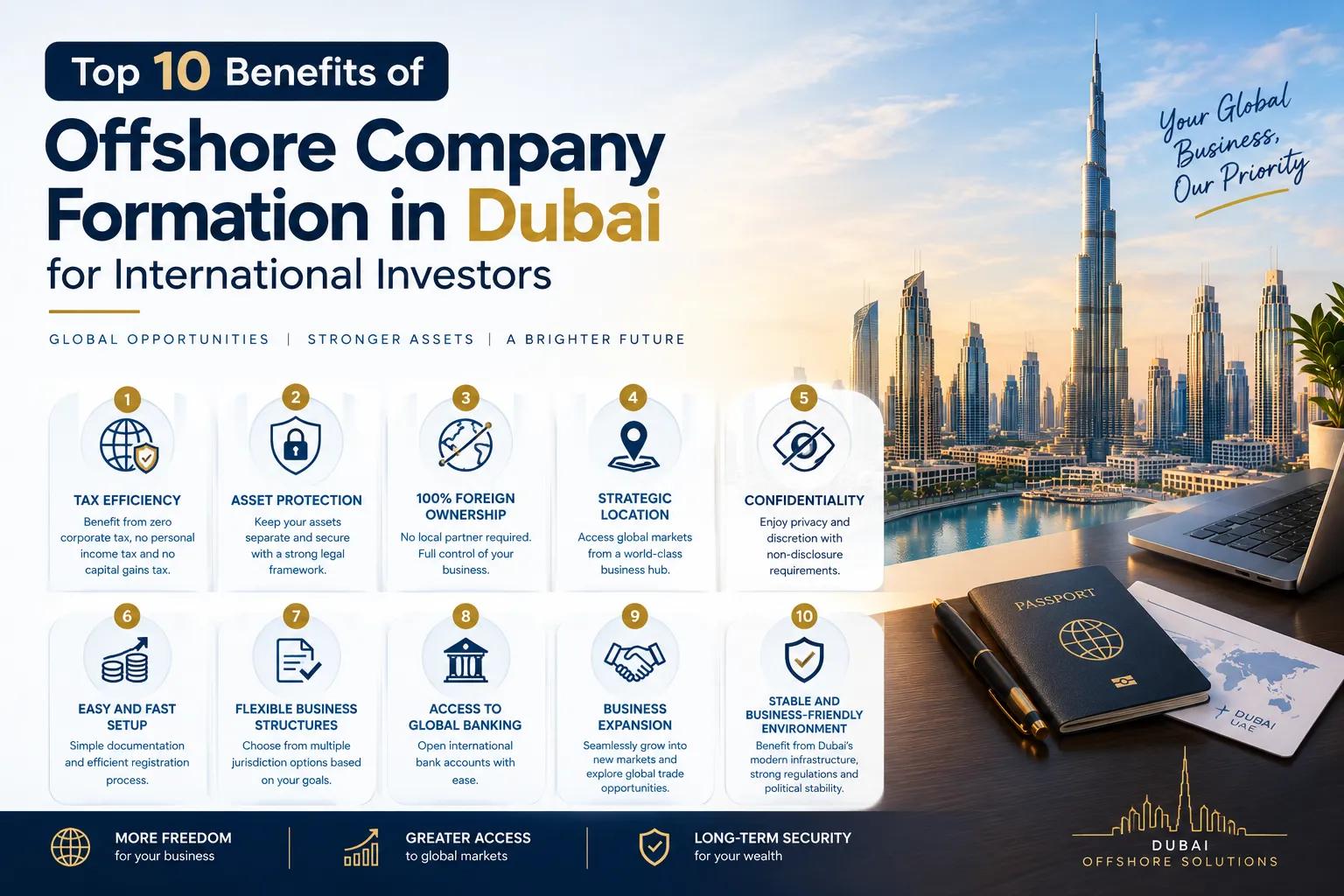
benefits of offshore company formation in Dubai

Dubai has become a popular destination for international investors seeking flexible corporate structures for managing investments, holding assets, and supporting cross-border business interests. Its strategic location and established business environment make the UAE an attractive jurisdiction for investors with international objectives.
An offshore company can be particularly useful for investors whose activities are primarily international. Depending on the chosen jurisdiction and structure, it may be used for holding investments, owning certain assets, managing subsidiaries, international trade, intellectual property, and wealth planning.
Understanding the potential advantages is important before selecting this type of structure. The right option depends on the investor's objectives, intended activities, banking requirements, assets, and compliance obligations.
Here are the top 10 benefits of offshore company formation in Dubai that international investors should consider.
1. 100% Foreign Ownership
One of the major advantages for international investors is the ability to retain full ownership of an offshore company.
This provides greater control over corporate decisions, investment arrangements, and long-term business planning. For foreign entrepreneurs, full ownership can also simplify the process of establishing a corporate structure without requiring a local shareholder where the selected jurisdiction permits complete foreign ownership.
2. Flexible International Business Structuring
Offshore companies can provide a practical structure for investors whose business interests extend across multiple countries.
An investor may use an offshore company as a holding or investment vehicle for certain international interests, depending on the applicable regulations.
This can help organise ownership of subsidiaries, investments, or other permitted assets under a central corporate structure.
3. Asset Holding and Protection
Asset structuring is another reason international investors consider offshore companies.
A properly structured company may be used to hold certain assets separately from an individual's personal ownership. This can support more organised asset management and risk planning.
However, asset protection is not automatic. Investors should consider applicable creditor, tax, inheritance, ownership, and regulatory laws before transferring assets into an offshore company.
4. Efficient Holding Company Structures
International investors with interests in multiple companies may benefit from establishing a holding structure.
Instead of holding shares in different businesses directly, an investor may use a suitable corporate entity to centralise ownership.
This can make certain aspects of corporate administration, investment management, and succession planning easier to organise.
5. Banking Opportunities
Access to suitable banking arrangements is an important consideration for international investors.
Depending on the structure and bank, an offshore company may support local or international banking relationships for managing legitimate business and investment transactions.
However, company incorporation does not guarantee bank account approval. Banks conduct their own KYC, source-of-funds, business-activity, and risk assessments.
Investors should therefore consider their banking objectives before choosing an offshore structure.
6. Support for International Investments
Investors often have assets and business interests across several jurisdictions.
An offshore company can potentially serve as a corporate vehicle for certain international investment and holding activities, subject to applicable laws.
This can help investors organise international shares, investment interests, intellectual property, or other permitted assets through a central structure.
The key is to ensure that the structure is established for legitimate purposes and that all relevant tax and reporting requirements are properly addressed.
7. Potentially Lower Administrative Requirements
Certain offshore structures can have fewer operational requirements than companies established to conduct day-to-day commercial activities.
For investors who need a holding or investment vehicle rather than an operating company with employees, premises, and local commercial activities, this can make an offshore structure more practical.
However, offshore companies still have ongoing responsibilities, including maintaining corporate records, meeting KYC and beneficial ownership requirements, and completing applicable annual renewals.
8. Greater Capital Management Flexibility
Capital management is an important consideration for investors with international portfolios.
Depending on the chosen jurisdiction and applicable regulations, an offshore structure may provide flexibility in managing and transferring legitimate corporate capital.
However, investors should distinguish corporate structuring benefits from tax treatment. The ability to move funds does not automatically mean that transactions are exempt from tax in the investor's country of residence or another relevant jurisdiction.
Professional cross-border tax advice is therefore important when dealing with substantial international investments.
9. Flexible Structures for Different Investment Objectives
International investors do not all have the same requirements.
One investor may need a holding company, while another may require a structure for wealth planning, intellectual property, investment assets, or ownership of subsidiaries.
Different offshore jurisdictions and corporate structures can accommodate different objectives.
This makes it important to evaluate the investor's actual requirements before selecting a company type. The most suitable structure should be based on the intended activities, assets, ownership arrangements, banking requirements, and long-term goals.
10. Support for Wealth and Succession Planning
Offshore structures can also form part of broader wealth and succession planning arrangements.
Investors with multiple businesses, investment assets, or family-owned wealth may use appropriate corporate structures to organise ownership and establish governance arrangements.
A well-planned structure can help create clearer ownership arrangements and facilitate long-term management of assets.
However, succession planning should take into account inheritance laws, tax residence, asset location, family circumstances, and regulations in all relevant jurisdictions.
Important Considerations Before Forming an Offshore Company
Although the advantages can be significant, offshore company formation is not suitable for every investor.
One of the most important considerations is understanding the permitted activities of the selected jurisdiction. An offshore company is generally designed for international or holding purposes and may not be permitted to conduct ordinary commercial activities within the UAE.
Investors should also evaluate:
Intended business and investment activities
Ownership and shareholder requirements
Registered-agent requirements
Banking objectives
KYC and beneficial ownership obligations
Annual renewal requirements
Corporate tax and other applicable tax rules
Tax residence and reporting obligations
Asset ownership rules
Succession and inheritance considerations
Regulations in countries where the investor operates
The objective should be to establish a structure that is commercially useful and compliant rather than choosing an offshore company solely because of perceived tax or privacy advantages.
How to Choose the Right Offshore Structure
Choosing the right structure starts with identifying the investor's primary objective.
An investor looking to hold international shares may have different requirements from someone planning to hold property, intellectual property, or subsidiaries.
Before proceeding, investors should consider whether the structure needs to:
Hold shares in other companies.
Own investment assets.
Support international business activities.
Hold intellectual property.
Support wealth or succession planning.
Facilitate suitable banking arrangements.
Separate certain assets from operating activities.
Form part of a wider UAE corporate structure.
It is also important to distinguish an offshore company from a UAE operating company. Free zone and mainland companies can provide licensed commercial activities, while offshore structures are generally designed for international, holding, and investment purposes.
Final Thoughts
The benefits of offshore company formation in Dubai can make this structure attractive to international investors seeking flexibility in asset holding, international investments, ownership, corporate structuring, and wealth planning.
However, the advantages depend on selecting the appropriate jurisdiction and structure. An offshore company should not be viewed as a universal solution for reducing taxes or protecting assets. Its suitability depends on the investor's objectives, tax residence, asset location, business activities, and compliance requirements.
International investors considering this option can benefit from professional guidance when comparing jurisdictions, assessing banking and compliance requirements, and planning the formation process. Dubai Business and Tax Advisors (DBTA) can assist investors in evaluating suitable offshore structures and aligning company formation with broader business, tax, and asset-planning objectives.
Ultimately, the right offshore structure is one that provides flexibility while remaining commercially practical, transparent, and compliant across all relevant jurisdictions.